Microsoft has announced plans to convert the long-vacant Foxconn LCD factory in Wisconsin into what it claims will be the “world’s most powerful” AI data center. The ambitious \$3.3 billion project, named the Fairwater AI campus, is slated to become operational in early 2026 and marks a significant step in the expansion of Microsoft’s artificial intelligence infrastructure and cloud computing capabilities.
Repurposing the Foxconn Site
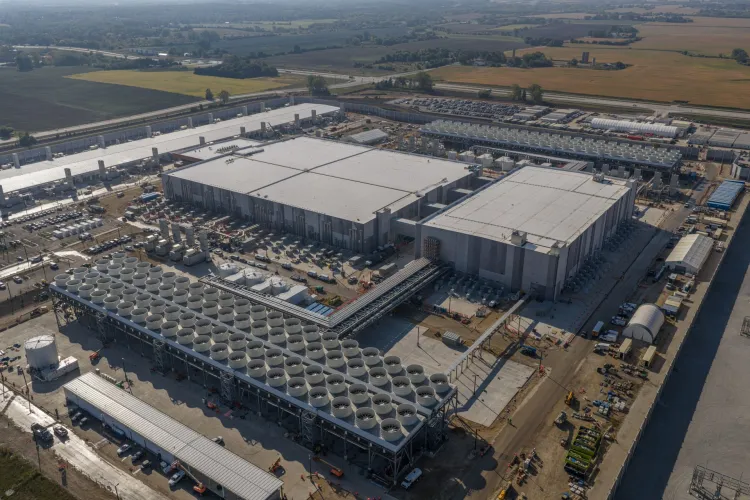
The Wisconsin site originally housed a Foxconn LCD factory, first announced in 2017 but widely criticized as a “boondoggle” due to production delays and underperformance. The facility sits on 315 acres and consists of three enormous buildings totaling 1.2 million square feet. By repurposing these underutilized structures, Microsoft aims to leverage existing infrastructure while revitalizing the local economy and workforce. This adaptive reuse not only saves on construction costs but also aligns with Microsoft’s strategy of scaling AI capacity rapidly to meet growing demand for advanced AI services and cloud computing solutions.
Unprecedented AI Computing Power
The Fairwater AI data center will host hundreds of thousands of Nvidia GB200 GPUs, interconnected with fiber networks so extensive that Microsoft claims they could circle the Earth 4.5 times. Satya Nadella, Microsoft’s CEO, described the GPU cluster as roughly ten times more powerful than the fastest traditional supercomputer, enabling massive acceleration of AI training workloads, including large-scale language models, generative AI, and other machine learning applications. The scale of the Fairwater facility positions Microsoft as a leading competitor in global AI infrastructure, competing with both tech giants and emerging AI-focused startups.
Sustainable and Energy-Efficient Design
Microsoft has emphasized the environmental sustainability of the new AI campus. The Fairwater data center will implement a closed-loop cooling system designed to minimize water consumption. Unlike traditional water-cooled data centers, this system only requires a one-time fill and then remains sealed, eliminating evaporation and conserving local water resources such as Lake Michigan. Sustainability is a critical concern for AI infrastructure, as the energy demands of massive GPU clusters and high-performance computing can be immense. By integrating environmentally conscious design features, Microsoft demonstrates a commitment to balancing AI growth with ecological responsibility.
Strategic Implications for AI and Cloud Computing
The Wisconsin AI campus is expected to significantly enhance Microsoft’s AI research, cloud computing, and enterprise services. By centralizing AI training at such scale, Microsoft can reduce latency, improve computational efficiency, and accelerate innovation across Azure AI, Microsoft 365 Copilot, and other cloud-based products. This infrastructure will allow faster iteration of AI models, more robust training on massive datasets, and quicker deployment of AI-powered solutions for businesses, government agencies, and academic institutions.
Furthermore, establishing the Fairwater AI campus in Wisconsin expands Microsoft’s geographical distribution of data centers, enhancing redundancy, security, and disaster recovery capabilities. The strategic location also benefits the Midwest region economically, creating construction jobs, technical positions, and long-term employment opportunities in AI operations and data center management.
Economic and Regional Impact
Transforming the Foxconn factory into an AI hub signals a shift in Wisconsin’s industrial landscape from traditional manufacturing to high-tech innovation. Local officials anticipate that the project will attract ancillary technology companies, research partnerships, and skilled workforce development initiatives. The conversion also demonstrates how existing industrial sites can be repurposed for emerging technological needs, serving as a model for other regions facing underutilized infrastructure.
Future Outlook for Microsoft’s AI Expansion
Microsoft plans to build multiple Fairwater data centers across the United States, indicating a long-term commitment to AI leadership. Each facility will likely feature similar high-performance GPU clusters, energy-efficient designs, and scalable architecture capable of supporting next-generation AI workloads. The Wisconsin campus will serve as a cornerstone of this national strategy, helping Microsoft maintain a competitive edge in the AI and cloud computing sectors while advancing corporate sustainability goals.
Conclusion
By turning Foxconn’s idle buildings into the world’s largest AI data center, Microsoft is setting a new benchmark for AI infrastructure, sustainability, and regional economic revitalization. The Fairwater AI campus combines cutting-edge GPU technology, massive computational power, and environmentally conscious design to support rapid growth in artificial intelligence research and cloud services. As the facility prepares to go online in 2026, it underscores Microsoft’s commitment to leading in AI innovation, transforming Wisconsin’s industrial landscape, and demonstrating how strategic infrastructure investments can align technological advancement with economic and environmental priorities.